
Tuesday, March 31, 2009
AWOL / MIA

Tuesday, March 24, 2009
Trucker Slang - Parking Lot with Seat Covers
Through my journey to many websites and online groups to pick up more info and ideas for my blog, I've ran across quite a lot of "trucker lingo" and as an English major and student of linguistics, I find it fascinating and so I've started to collect a list of terms & translations.
Alligator - Chunk of a blown tire in the road
Parking Lot - Car Hauler
10-12 - Visitor Present
10-42 - Traffic Accident
10-73 - Speed Trap
10-100 - Rest stop
So....10-23 everyone.... there's more to come ;-)
Friday, March 20, 2009
Facelift!
I owe big thanks to a very helpful and knowledgeable gentleman who during the past couple of weeks have taught me a lot about CSS and provided me with his valuable input regarding design & what looks good & better and so on.
You can find his blog here: Terry's Playpen
There are lot of good tips there on how to spiff up your blog.
He also has another blog that's definitely worth a read, and you can find that one here: Paradise Discovered
Thanks so much Terry!!! :-)
Wednesday, March 18, 2009
Big Rig of the Week - The Circus Comes to Town!


Personally I remember going to the circus with my family... my mom, brother and dad, sometimes friends would even join us. We'd get popcorn and sodas, some would get cotton candy but I never cared for that. It's way too sweet. Then we'd sit in a smelly tent for a couple of hours, but it was magical ... it was like stepping into a different world for a couple of hours while watching magic acts and breath taking stunts. I realize now that even as a kid it was great to escape reality once in awhile.
So... The circus is in town. It must have been 15 years since I went to the circus. As you can see, I never made it into the circus tent here.... but they're here for one more week, so perhaps next time I'll make it past the big rigs and in to the actual show ;-)(Note: I actually didn't stand outside the entire night and take photos until the sun came up... I came across these truck at night so I took a few shots, then came back to take some better ones during daylight the next day....)
Thursday, March 12, 2009
Big Rig Chronicles: The Peterbilt
As with the Kenworth, the logging industry played a big part in the development of the Peterbilt and indirectly, so did World War I.
World War I spawned a need for more efficient deliveries of food and supplies, and the government was forcing more and more motorized trucks into service. Previous to this, there had been a lack of good roads to drive on, which had held back the trucking industry. As the need for better transportation grew due to the war, so did the need for better highways and the government willingly provided them.
This development sped up society and increased efficiency on many levels. T.A Peterman’s lumber business was growing fast and floating freshly cut logs down the river from the forest to the mill, or hauling them off to the mill by horse, no longer seemed efficient enough, so he started developing technologies and building trucks that could accommodate his needs.
Peterman started by rebuilding army surplus trucks, constantly upgrading and making them into better models by improving the technology. Soon he developed a need for a place where he could build custom logging truck chassis, and in 1938 he acquired the assets of a virtually dead truck manufacturer (Fageol Motors, Oakland, CA) and started producing custom trucks. Peterman’s trucks were built exclusively for his lumber company and they were specifically designed and customized to meet all his needs within the industry. His trucks became available for sale to the public in 1939. Peterman was mostly concerned with the quality of his trucks and produced only 100 trucks a year. He started sending his engineers into the field so they could make modifications to their trucks based on issues that truckers were facing in their day-to-day operation.
During World War II, Peterbilt was contracted by the government to produce heavy-duty trucks. The experience and skills that Peterman and his engineers acquired during this time was invaluable, and were later applied to his commercial trucks after the war.
In 1945, Peterman passed away and his widow sold the trucking company, without the land, to seven Peterbilt managers, who were able to expand the business and soon Peterbilt became a large-scale producer of big rigs.
T.A Peterman’s passion for his trucks and his dedication to the quality of his product spawned a loyal following of truck lovers and truck manufacturers from the very beginning. Through the years, the trucking world’s loyalty has not faded nor strayed, and that is why the Peterbilt is still one of the most known and reputable trucks of today.
Wednesday, March 11, 2009
Wide Load - What are they transporting?
“What’s in there?”
It's entirely possible that this is not a common thought unless you actually are in to trucks… I really have no clue what normal people are thinking.... :))
Anyway, regardless of that, I wonder sometimes as I pass some of these trailers, what they contain, so I wanted to post a blog on different types of trailers and cargo.
Chemicals
Every truck transporting some kind of chemical has a colored placard on the back of the trailer with a 4-digit number on it.
This placard identifies exactly what’s in the tank, that way if an accident and a spill occurs, emergency crews will quickly be able to identify what type of liquid they are dealing with. The numbers are designated by the UN or DOT and are referred to as UN/NA numbers or DOT numbers. The placard will immediately identify which type of chemical it is (explosive, corrosive, flammable etc) whereas the numbers provide more specific info on which particular chemical is being transported.
(This is actually a good piece of information to have, in case you are ever in such a situation and need to call 911. Informing the dispatcher of the DOT number & placard will be very helpful!)
One of the most common placards is this one for gasoline, I'm sure everyone has seen this one:

Here’s a placard for liquid oxygen:

I actually looked up what liquid oxygen is used for, because I see this transported a lot. Other than the fact that it’s really cold, I didn’t really know its purpose. Not a big shock to learn that it’s used in the medical industry, but the military and aircraft industry also use it as a source of breathing oxygen and it is also used in the space craft industry.
Just one of many, many chemicals that I have no clue what it’s used for, but the frequent sighting of trucks carrying liquid oxygen finally prompted me to look up what the big deal was :-))

It means “dangerous when wet” (and yes, get your minds out of the gutter, I can see it splashing around there!)
It means that the chemical can potentially become flammable, toxic or explosive when paired with certain ratio of water. (Again…the gutter….get out…. )
I’m not going to post the entire list of DOT chemical numbers here, but if you are curious of what some of them are, here is a website with a complete listing of numbers and placards:
http://environmentalchemistry.com/yogi/hazmat/
Drivers need special endorsements on their driver’s license to haul hazardous materials as well as to haul liquid bulk.
Ok, now let’s move on to other transports.
Here’s a trailer I never knew what contained:

Turns out these are for dry bulk transport, such as grain, flour, sugar, animal foods, wood chips etc. (Trailer photo borrowed from http://www.beall.com/)
These trailers have become pretty fancy. They are equipped with mechanical cooling systems, or some of them use CO2 to cool off the trailer, either in form of dry ice or liquid co2. I’m partial to this photo I found, as it has a cool-looking Kenworth pulling the trailer. Photo was borrowed from http://www.oocl.com/.
Milk Truck refrigerated tankers transporting milk from dairy farms to the factory so you and I can enjoy our Oreo cookies the way they should be enjoyed --- thoroughly dunked in cold milk!
This last one is just a cool pic I found while looking around for funky transports... Looks like the entire road needs to be roped off for this bad boy to pass through. Not much passing room there!
Well, I could post a lot of photos of a lot of different trailers, but I just wanted to touch on some of the more curious ones... Should the urge be there to further explore the different trailers, there is an excellent trailer identification chart to be found here:
http://wwwapps.tc.gc.ca/saf-sec-sur/3/erg-gmu/erg/roadtrailer.aspx
(Don't ask me how I find these sites...lol....but I'm sure they'll welcome your visit!)
Monday, March 9, 2009
Sharing the Road with Big Rigs - Blind Spots
I want to dedicate a lot of this blog space to traffic safety when it comes to cars & big rigs.
75% of all car-big rig accidents are caused by the driver of the car, not the truck driver and that’s a stat I believe.
I commute a lot. I drive about 35 miles each way to and from work, 5 days a week, and boy do I see some stupid driving, especially when it comes to small cars vs. semis. (And mind you, ALL cars are small compared to big rigs….)
In this post, I want to write about blind spots.
Blind Spots.
All cars have them. There is nothing as scary as readying yourself to change lanes, you think that the lane next to you is wide open and then all of a sudden you spot a sucker that has been lurking in your blind spot for the past few minutes. It’s enough to give a person a heart attack.
On a regular car, the blind spots are few & they are small. We also have the luxury of being able to turn our heads and look over our shoulder before we merge, to make sure nobody is riding in our blind spot. A truck driver can’t do that. If he turns his head and looks over his shoulder, he’ll see the back of his cab!
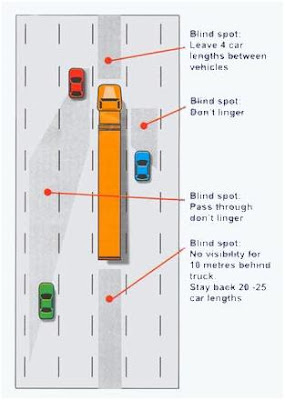
A big rig has a lot of blind spots, and some of these blind spots do in fact span across several freeway lanes. Let’s go through them.
1. Front of the Truck: This blind spot ranges out about 20 feet ahead of the semi. The driver won’t see you there. Merging in this close to a big rig can be fatal. Make sure you leave about 4 car lengths between your car and the big rig.
2. Rear of the Truck: About 30 feet directly behind the trailer and you should keep a distance of 25 car lengths. The problem is that when you drive behind a big rig, you can’t see what is going on ahead of you in traffic. You can only trust that the brake lights on the rig in front of you are working properly and that the truck driver is able to hit his brakes in time should something cause a sudden stop. If you are driving too close to the rear end of a big rig and a sudden stop happens, it too could be fatal.I suppose that if you are driving behind a big rig, which sometimes happens, especially on busy freeways, you should drive at a speed that will allow you to stop in time should a sudden stop occur.
3. Left Side of the Truck: a 3-lane span, starting at the end of the truck cab and running down the entire length of the truck. Passing on the left side of a big rig is the correct thing to do, however don’t linger. Make your passing a quick one so that you will be visible again to the driver as fast as possible.
4. Right Side of the Truck: Some trucks have a sticker on the back that says:
<< LEFT - Pass ********* RIGHT – Suicide >>
This sticker isn’t for comedy or posted as a joke. Passing a big rig on the right had side could very well be the last thing you do in life. I don’t mean to be morbid, but that’s a fact. The blind spot on the right hand side of a big rig also fans out for about 3 lanes and runs the length of the truck, but this blind spot is a lot less forgiving than the one on the left.The truck driver may very well see you when you enter the blind spot, but if you linger there and he no longer sees you, he could forget that you are there. If by any chance he has to make a sudden swerve to avoid a collision or an object in the lane, there is no chance he remember that you are still next to him if he can’t see you.
I bring up the word “fatal” a lot because if you end up in an accident vs a big rig, the chances of you walking away could be minimal. I read somewhere that 78% of small cars vs big rig accidents end in fatality. 78%! And these small cars are the ones I constantly see darting in and out of traffic, passing on the right, passing on the left, cutting off big rigs left and right (and everyone else for that matter). Seriously. You may think you’re the best driver in the world but be cautious when passing big trucks. Unpredictable incidents in the roadway happen a lot, and you want to be visible to a truck driver at all times so that if he does have to make a sudden move, he knows you’re there!
So…blind spots. We all hate them. I’m sure truck drivers despise them. But they’re there. Just be aware of them. And don’t pass on the right!